
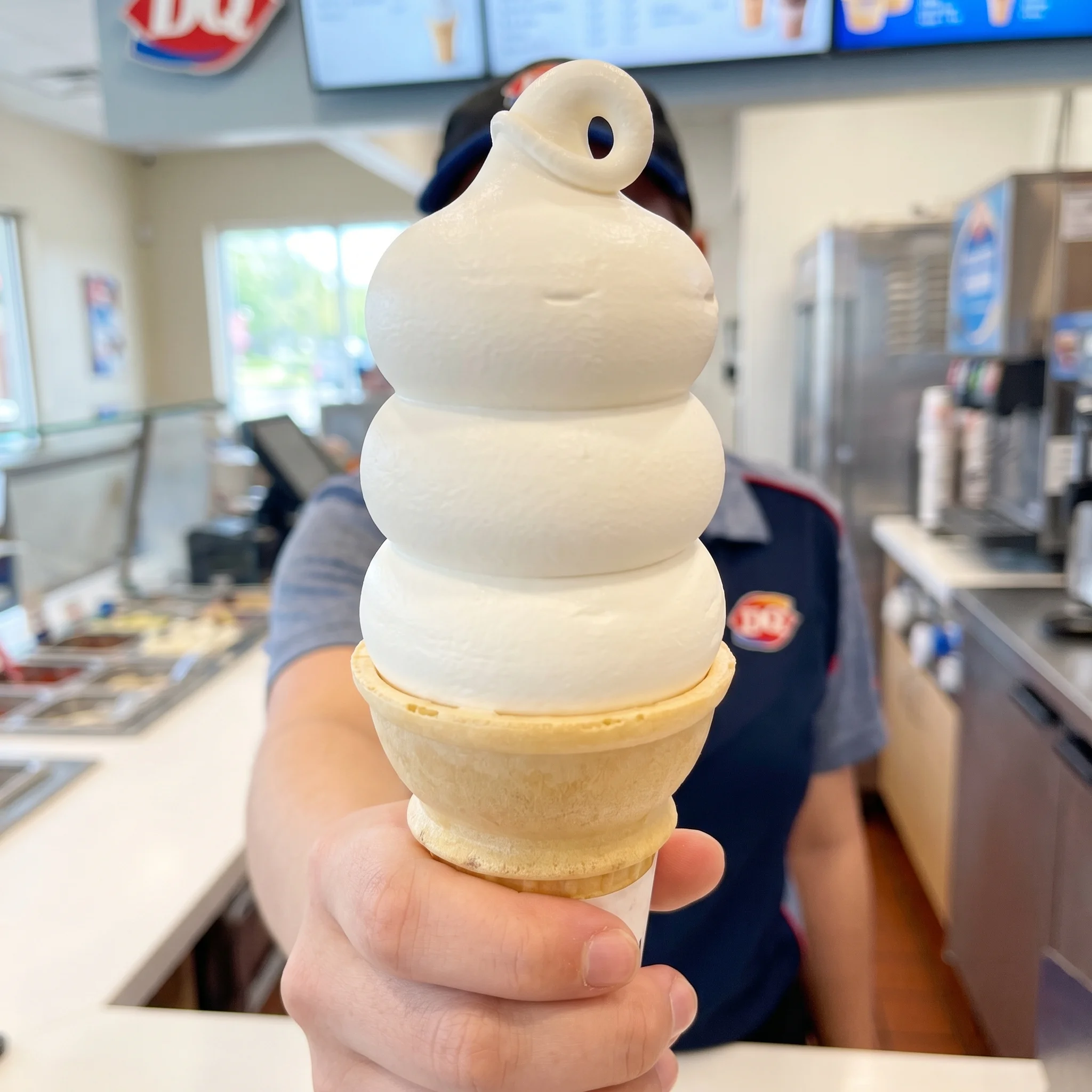
Examine any official Dairy Queen marketing billboard, paper cup, or illuminated menu board in America, and you will notice a conspicuous linguistic absence: the words "ice cream" never appear next to the company name. Instead, corporate communications carefully deploy terms like "Soft Serve," "Blizzard® Treats," and "Frozen Dairy Desserts." This is not a marketing whim or casual stylistic branding—it is strict compliance with federal food identity laws enforced by the United States Food and Drug Administration (FDA). Here is the food biochemistry and regulatory science behind why Dairy Queen is legally barred from using the ice cream label, and why that exact formula makes it so irresistible.
The Legal Mandate: FDA Title 21 CFR § 135.110
Under Title 21 of the Code of Federal Regulations, the United States government maintains a strict legal "Standard of Identity" for Ice Cream. Originally codified to protect consumers from dairy distributors diluting cream with skim milk and water, the statute sets uncompromising minimum thresholds:
The Federal Standard of Identity Rules
- Mandatory 10% Milkfat Minimum: Any commercial frozen dessert labeled "ice cream" must contain at least 10% butterfat by weight. Super-premium parlor brands (like Häagen-Dazs or Ben & Jerry’s) typically contain 14% to 18% butterfat.
- Milk Solids Requirement: The finished product must contain no less than 20% total milk solids.
Dairy Queen’s proprietary soft-serve recipe contains exactly 5% milkfat. Because its butterfat content is precisely half the federal minimum standard, calling it "ice cream" on any commercial surface would constitute false advertising and misbranding under federal law.
Thermodynamic Science: Why 18°F Beats 0°F
A casual observer might assume having 5% butterfat instead of 10% makes Dairy Queen inferior. In reality, food biochemists deliberately chose this formulation to solve a major sensory problem inherent to hard ice cream: sensory numbing.
| Scientific Characteristic | Hard-Pack Parlor Ice Cream | Dairy Queen Soft Serve | Sensory Impact |
|---|---|---|---|
| Butterfat (Milkfat) % | 10% to 16% | 5% (Reduced Fat) | DQ leaves zero greasy wax coating on the palate |
| Dispensing Temperature | 0°F to 5°F (-18°C) | 18°F (-8°C) | 18°F prevents tastebud freezing; instant flavor bloom |
| Air Incorporation (Overrun) | 20% to 30% (Dense) | 40% to 45% (Aerated) | Yields velvety, spoonable cloud texture |
| Ice Crystal Geometry | Macro-crystals (Hardened) | Micro-crystals (Continuous) | Silky smooth glide across the tongue |
| Caloric Density (100g) | 260 – 310 calories | 140 – 160 calories | Nearly 45% lower fat load per volume |
The Physics of the Upside-Down Flip
How does a Dairy Queen Blizzard defy gravity when the crew member flips it upside-down before your eyes? This is not magic; it is fluid dynamics and colloidal chemistry:
- Micro-Air Bubble Entrainment: The pressurized continuous-feed freezer barrels whip 40% to 45% air into the liquid dairy mix. This process, known as overrun, suspends millions of microscopic air pockets throughout the milkfat emulsion.
- High Yield Stress: When the Blizzard is blended on the high-speed spindle with chilled mix-ins like crushed cookies or candy, the friction and cold create a thixotropic colloidal suspension. The treat behaves as a solid when resting, resisting gravitational pull until external mechanical stress (your spoon) is applied.
Ingredient Transparency: Debunking Urban Myths
Conspiracy theories online frequently claim that Dairy Queen soft serve is made of pig lard, synthetic petroleum oils, or chemical foams. The reality is clean and straightforward:
- Real Grade-A Milk & Milkfat: Delivered in liquid bag-in-box totes from domestic American dairy cooperatives.
- Whey Protein Concentrate: Natural dairy protein that strengthens the ice crystal framework and prevents syneresis (liquid weeping).
- Natural Plant Hydrocolloids: Minute quantities of guar gum (from guar beans) and carrageenan (from edible red seaweed) act as natural stabilizers to keep the dairy emulsion homogenous during freezing.
The Mechanics of the Patented DQ "Curl"
Every newly inducted Dairy Queen employee spends hours practicing the geometry of the signature curl. The process requires establishing a wide circular base on the cone, pulling two concentric ascending spheres, and performing a precise downward compression followed by a sharp, upward wrist-snap. This snap breaks the surface tension of the soft serve at the exact apex, forming the iconic royal curl.
Frequently Asked Questions
Experience the Signature Soft Serve
Check out full pricing and size options for cones, sundaes, and Dilly Bars.